

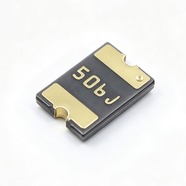


Bourns MF-MSMF050-2 Resettable Fuse 0.50A 15V 1812
Bourns MF-MSMF050-2 resettable fuse, 0.50A hold, 15V max, 1812 package, 100A interrupt
The MF-MSMF050-2 is an 1812 surface-mount resettable fuse with a 0.50 A hold current and a 15 V maximum voltage. It measures 4.5 × 3.2 mm, has gold-plated terminals, and is suitable for reflow soldering. UL, CSA and TÜV recognised, RoHS compliant. With a 100 A interrupt rating it is used on 5 V and 12 V supply outputs, USB charging ports and set-top boxes.
Category:Resettable fuse / SMD, 1812 SMD (4532 mm)
Voltage:15 V; Current:hold 0.5 A; trip 1 A.
Specifications
| Parameter | Value |
| Hold current | 0.5 A |
| Trip current | 1 A |
| Maximum voltage | 15 V |
| Maximum fault current | 100 A |
| Initial resistance | 0.15 Ω |
| Post-trip max resistance | 1 Ω |
| Trip current / time | 8 A / 0.15 s |
| Dissipated power | 0.8 W |
| Package | 1812 SMD (4532 mm) |
Temperature Derating
| -40℃ | -20℃ | 0℃ | 23℃ | 40℃ | 50℃ | 60℃ | 70℃ | 85℃ | |
| Hold current (A) | 0.77 | 0.68 | 0.59 | 0.5 | 0.44 | 0.4 | 0.37 | 0.33 | 0.29 |
| Share of 23 °C rating | 154% | 136% | 118% | 100% | 88% | 80% | 74% | 66% | 58% |
Product Description
What this product is
The MF-MSMF050-2 is a polymer resettable fuse with a 0.50 A hold current and a 15 V maximum voltage. It sits at the output of a supply and opens when the load shorts or a connector is bridged by debris. Once the fault is cleared and the part cools, it returns to conduction, with no component replacement.
Dimensions and appearance
1812 package, 4532 in metric, 4.5 mm long, 3.2 mm wide and 0.75 mm high. Gold-plated terminals at both ends, black body, with the model code and production lot marked on top. Supplied on tape and reel for automatic pick-and-place, and also suitable for hand soldering. The body and footprint match the other 1812 parts in the series; the voltage rating shows in the body marking and the reel label, so check the label when changing reels.
How it works
The fuse sits in series with the circuit. At 23 °C and 0.50 A it presents 0.15 Ω, which is 0.075 V across it, 1.5% of a 5 V rail. Above 1.00 A the internal material expands with heat and its resistance rises sharply, limiting the current to a small value. At 8.0 A it opens within 0.15 s.
After the fault is cleared
When power is removed or the fault disappears and the part cools, it returns to its low-resistance state and the circuit resumes normal operation. Post-trip resistance is 1.0 Ω maximum, which is 0.5 V at 0.50 A. On a 5 V rail that is 10% of the supply, so confirm the downstream devices still have enough voltage after a trip.
Parameters and selection
Full parameters are in the datasheet, downloadable from this page, including temperature derating, time-current curves and package dimensions. This part does not go on a 24 V rail; the 24 V and 33 V versions at the same current cover those systems. For lot confirmation, stock enquiries or parameter-based alternatives, please contact our sales team.
Selection Notes
1. 15 V is a hard limit, and a 24 V rail is outside it
A 24 V nominal supply reaches 28.8 V while charging, with switching transients above that. Against 28.8 V the 15 V maximum voltage punctures the fuse on the first power-up, the element opens, and the whole board loses power. The 100 A interrupt rating describes the fault current the fuse can break safely, a separate quantity from the voltage it can withstand. For 0.50 A on a 24 V rail, use the 24 V or 33 V version.
2. Its hold current derates the least in this series
At 85 °C it still holds 0.29 A, 58% of the 23 °C rating, and 0.37 A at 60 °C. The 0.10 A part in the same series falls to 30% at 85 °C. In a warm enclosure with poor airflow, this current class keeps more usable margin than the small-current parts.
3. For 24 V, the Joincircuit equivalents hold the same resistance
The Joincircuit ASMD1812-050-24V, -30V and -33V carry the same hold current as this fuse and the same 1.0 Ω maximum post-trip resistance, with voltage ratings from 24 V to 33 V, so the voltage drop on the board stays unchanged. The 60 V version rises to 1.4 Ω post-trip, and circuits that are sensitive to voltage drop need that recalculated.