

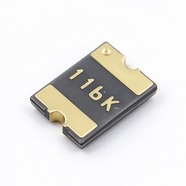


Bourns MF-MSMF110-2 Resettable Fuse 1.10A 6V 1812
Bourns MF-MSMF110-2 resettable fuse, 1.10A hold, 6V max, 1812 package, 0.04 ohm Rmin
The MF-MSMF110-2 is a 1812 surface-mount resettable fuse with a 1.1 A hold current and a 6 V maximum voltage. It measures 4.5 × 3.2 mm, has gold-plated terminals, and is suitable for reflow soldering. UL, CSA and TÜV recognised, RoHS compliant. Commonly used for overcurrent protection on USB ports, 5 V power modules, set-top boxes and portable devices.
Category:Resettable fuse / SMD, 1812 SMD (4532 mm)
Voltage:6 V; Current:hold 1.1 A; trip 2.2 A.
Specifications
| Parameter | Value |
| Hold current | 1.1 A |
| Trip current | 2.2 A |
| Maximum voltage | 6 V |
| Maximum fault current | 100 A |
| Initial resistance | 0.04 Ω |
| Post-trip max resistance | 0.21 Ω |
| Trip current / time | 8 A / 0.3 s |
| Dissipated power | 0.8 W |
| Package | 1812 SMD (4532 mm) |
Temperature Derating
| -40℃ | -20℃ | 0℃ | 23℃ | 40℃ | 50℃ | 60℃ | 70℃ | 85℃ | |
| Hold current (A) | 1.59 | 1.43 | 1.26 | 1.1 | 0.95 | 0.87 | 0.8 | 0.71 | 0.6 |
| Share of 23 °C rating | 145% | 130% | 115% | 100% | 86% | 79% | 73% | 65% | 55% |
Same-Package Alternatives
| Model | Vmax | R1max | Package | Note |
| MF-MSMF110/16 | 16 V | 0.21 Ω | 1812 SMD (4532 mm) | |
| MF-MSMF110/24X | 24 V | 0.18 Ω | 1812 SMD (4532 mm) |
Product Description
What this product is
The MF-MSMF110-2 is a polymer resettable fuse. The difference from a one-time fuse lies in what happens after it trips: a one-time fuse must be replaced, whereas this part restores conduction by itself once the fault is cleared and the temperature falls, with no manual replacement needed.
Dimensions and appearance
1812 package, 4532 in metric, 4.5 mm long, 3.2 mm wide and 0.75 mm high. Gold-plated terminals at both ends, black body, with the model code and production lot marked on top. Supplied on tape and reel for automatic pick-and-place, and also suitable for hand soldering.
How it works
It is connected in series with the circuit. Under normal operation its own resistance is very low, 0.04 Ω, so the effect on the circuit is negligible. When the current through it exceeds 2.2 A, or when the ambient temperature rises, the internal material expands with heat and its resistance increases sharply, limiting the current to a small value and protecting the circuit behind it.
After the fault is cleared
Once power is removed or the fault disappears and the temperature falls, the part returns to its low-resistance state and the circuit resumes normal operation. No component replacement and no manual reset are required. The same part can trip and reset repeatedly.
Parameters and selection
Full parameters are in the datasheet, downloadable from this page. Temperature derating, time-current curves and package dimensions are all included. For lot confirmation, stock enquiries or parameter-based alternatives, please contact our sales team.
Selection Notes
1. 6 V is the lowest rating in the series — 5 V systems only
A 6 V Vmax means the working voltage has to stay below 6 V, which in practice means a 5 V rail. On a 12 V or 24 V system the device is over-volted from the first power-up and fails. For 1.10 A hold current on 12 V, use the /16 variant in the same series; for 24 V use /24X. All three share identical Ihold and Itrip — only Vmax differs, so changing the suffix is the whole job.
2. It has the lowest resistance of the three
Rmin 0.04 Ω, R1max 0.21 Ω — the smallest voltage drop in the series. At 1.10 A the initial drop is 44 mV. A 5 V rail has little headroom, and the 0.21 Ω post-trip resistance only adds 231 mV, which rarely pushes the downstream stage into undervoltage lockout. That is this part's real advantage over the higher-resistance versions, not an incidental number.
3. Joincircuit does not offer a 6 V version
The lowest Joincircuit 1812 device at 1.10 A is 8 V (ASMD1812-110), with R1max 0.25 Ω. An 8 V part substitutes for a 6 V application without risk — the withstand voltage is higher. But R1max rises from 0.21 Ω to 0.25 Ω, 19% more. On a drop-sensitive 5 V circuit that 19% matters; where it does not, the 8 V part is the safer choice.