

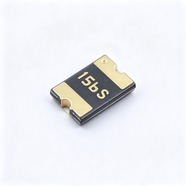


Bourns MF-MSMF150-2 Resettable Fuse 1.50A 6V 1812
1.50 A hold current, 6 V maximum voltage, 1812 (4532) package. 100 A interrupt, 0.12 Ω post-trip. The 6 V ceiling confin
The MF-MSMF150-2 is a 1812 surface-mount resettable fuse that carries 1.50 A continuously and withstands 6 V maximum. It measures 4.5 × 3.2 mm, has gold-plated terminals and suits reflow soldering. UL, CSA and TÜV recognised, RoHS compliant. Commonly used for overcurrent protection on 5 V main branches, multi-port USB hubs and board-level supply entries.
Category:Resettable fuse / SMD, 1812 SMD (4532 mm)
Voltage:6 V; Current:hold 1.5 A; trip 3 A.
Specifications
| Parameter | Value |
| Hold current | 1.5 A |
| Trip current | 3 A |
| Maximum voltage | 6 V |
| Maximum fault current | 100 A |
| Initial resistance | 0.03 Ω |
| Post-trip max resistance | 0.12 Ω |
| Trip current / time | 8 A / 0.5 s |
| Dissipated power | 0.8 W |
| Package | 1812 SMD (4532 mm) |
Temperature Derating
| -40℃ | -20℃ | 0℃ | 23℃ | 40℃ | 50℃ | 60℃ | 70℃ | 85℃ | |
| Hold current (A) | 2.17 | 1.95 | 1.72 | 1.5 | 1.3 | 1.18 | 1.09 | 0.97 | 0.82 |
| Share of 23 °C rating | 145% | 130% | 115% | 100% | 87% | 79% | 73% | 65% | 55% |
Same-Package Alternatives
| Model | Vmax | R1max | Package | Note |
| MF-MSMF150/24X | 24 V | 0.12 Ω | 1812 SMD (4532 mm) |
Product Description
What this product is
The MF-MSMF150-2 is a polymer resettable fuse connected in series in a 5 V main branch. Above 3.00 A the internal resistance rises and the current is held to a low value. Once the fault is cleared and the part cools, it conducts again, so the board stays in service. At 1.50 A it suits a board-level supply entry in place of a one-time fuse.
Dimensions and appearance
1812 package, 4532 in metric, 4.5 mm long, 3.2 mm wide and 0.75 mm high. Gold-plated terminals, black body, model code and production lot marked on top. The 24 V version at 1.50 A fits the same footprint and cannot be told apart by size, so confirm the 24X suffix on the reel label at goods-in.
How it works
It sits in series in the loop. At 23 °C and 1.50 A its own resistance is 0.03 Ω, which gives a drop of 0.05 V, or 1% of a 5 V rail. Above 3.00 A, or as ambient temperature rises, the internal material expands with heat, resistance climbs and the current is limited.
After the fault is cleared
When the part cools after a trip, resistance falls back to the low state and the loop runs again with no manual reset. After one trip the resistance is at most 0.12 Ω, 4 times the 0.03 Ω factory value, which gives 0.18 V at 1.50 A. The 0.12 Ω figure is the limit after repeated trips; check the downstream circuit against it.
Parameters and selection
The full datasheet is available for download on this page, covering the derating table, time-current curves and package dimensions. At 60 °C inside an enclosure the hold current is 1.09 A, and 0.82 A at 85 °C; size the load against those figures. Above 1.5 A check both the trip current and the voltage rating before stepping up; ask our sales team.
Selection Notes
1. One step up carries a lower trip current
The 1.60 A part, MF-MSMF160-2, trips at 2.80 A, below the 3.00 A of this part, and its voltage rating changes to 8 V. A board that draws 1.5 A with an inrush peak near 2.8 A trips the 1.60 A part at switch-on. Above 1.5 A, size against the trip current as well as the hold current, otherwise the margin comes out narrow.
2. The 24 V version shares this footprint and opens in 1.50 s
Two parts cover 1.50 A: this one at 6 V and the MF-MSMF150/24X-2 at 24 V. They measure the same and the suffix on the reel label is the only difference. The 24 V part takes 1.50 s to open at 8 A where this one takes 0.50 s, and its rated dissipation is 1.0 W. Confirm the suffix at goods-in; a mixed reel gives the board a different trip time.
3. 8 A takes 0.50 s to clear
The 1.50 A rating is large and clearing takes longer: at 8 A this part opens in 0.50 s where the 1.25 A part needs 0.40 s. For that half second the full 8 A flows through the traces and parts downstream. Check the 5 V branch traces, the connectors and the converter behind it against 8 A for 0.5 s; where they fail, add a one-time fuse ahead of this part.