

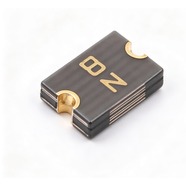


Bourns MF-MSMF150/24X-2 Resettable Fuse 1.50A 24V 1812
1.50 A hold current, 24 V maximum voltage, 1812 (4532) package. 20 A interrupt, 0.12 Ω post-trip. Same resistance as the
The MF-MSMF150/24X-2 is a 1812 surface-mount resettable fuse that carries 1.50 A continuously and withstands 24 V maximum. It measures 4.5 × 3.2 mm, has gold-plated terminals and suits reflow soldering. UL, CSA and TÜV recognised, RoHS compliant. The 24X suffix marks the voltage class; current and resistance match the 6 V MF-MSMF150-2. Commonly used for overcurrent protection on 12 V and 24 V supply inputs, USB power ports and small motor circuits.
Category:Resettable fuse / SMD, 1812 SMD (4532 mm)
Voltage:24 V; Current:hold 1.5 A; trip 3 A.
Specifications
| Parameter | Value |
| Hold current | 1.5 A |
| Trip current | 3 A |
| Maximum voltage | 24 V |
| Maximum fault current | 20 A |
| Initial resistance | 0.03 Ω |
| Post-trip max resistance | 0.12 Ω |
| Trip current / time | 8 A / 1.5 s |
| Dissipated power | 1 W |
| Package | 1812 SMD (4532 mm) |
Temperature Derating
| -40℃ | -20℃ | 0℃ | 23℃ | 40℃ | 50℃ | 60℃ | 70℃ | 85℃ | |
| Hold current (A) | 2.1 | 1.9 | 1.7 | 1.5 | 1.25 | 1.13 | 1 | 0.88 | 0.69 |
| Share of 23 °C rating | 140% | 127% | 113% | 100% | 83% | 75% | 67% | 59% | 46% |
Same-Package Alternatives
| Model | Vmax | R1max | Package | Note |
| MF-MSMF150 | 6 V | 0.12 Ω | 1812 SMD (4532 mm) |
Product Description
What this product is
The MF-MSMF150/24X-2 is a polymer resettable fuse connected in series between a supply and its load to limit current. The hold current, the current it carries continuously, is 1.50 A here, enough for a load of about 1 A such as a USB power port, a small motor driver board or a 12 V relay coil. Once the fault clears and the part cools, it conducts again and the board stays in place.
Dimensions and appearance
1812 package, 4532 in metric, 4.5 mm long, 3.2 mm wide and 0.75 mm high. Gold-plated terminals, black body, marked 8N. The 6 V MF-MSMF150-2 fits the same footprint and carries the marking 15bS, so size does not separate the two; check the marking and the reel label at goods-in.
How it works
It sits in series in the loop. At 23 °C and 1.50 A its own resistance is 0.03 Ω, a drop of 0.045 V, about 0.2% of a 24 V rail. Above 3.00 A the internal material expands with heat, resistance climbs and the current is held to a low value. At a fault current of 8 A it opens within 1.50 s.
After the fault is cleared
When the part cools after a trip, resistance falls back to the low state and the loop runs again with no manual reset. After one trip the resistance is at most 0.120 Ω, 4 times the 0.03 Ω factory value, which gives 0.18 V at 1.50 A. Check the downstream circuit against that limit after repeated trips.
Parameters and selection
The full datasheet is available for download on this page and covers the derating table, time-current curves and package dimensions. At 60 °C inside an enclosure the hold current is 1.00 A; at 85 °C it is 0.69 A. For a load above 1.20 A, read the table at the highest enclosure temperature and decide whether to step up one current class.
Selection Notes
1. At 85 °C it keeps 46% of rating, the lowest in the 24 V group
The rating is 1.50 A at 23 °C and 0.69 A at 85 °C, 46% of nominal. At the same 85 °C the 24 V MF-MSMF110/24X keeps 55% and the MF-MSMF075/24 keeps 57%. In an enclosure that stays above 70 °C, size the load against 0.88 A; a board specified at 1.50 A opens by itself once it sits in a hot enclosure.
2. Raising the voltage to 24 V takes the interrupt rating from 100 A to 20 A
Hold current, trip current and resistance are identical to the MF-MSMF150-2. The interrupt rating, the largest fault current the part can safely break, is 100 A on that part and 20 A on this one; at an 8 A fault the opening time stretches from 0.5 s to 1.50 s. Below 6 V, where fault current can reach 100 A, specify the MF-MSMF150-2.
3. On a full battery the 24 V rating leaves 1.2 V of margin
A fully charged 24 V battery pack reaches 28.8 V, above this part's 24 V ceiling, so a full pack already exceeds the rating. A 12 V adapter delivers 12 V to 13.8 V, which leaves margin to spare. On a rail fed straight from a 24 V pack, hold the voltage below 24 V or move to a model rated above 33 V.