

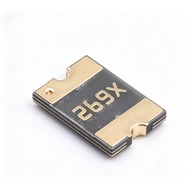


Bourns MF-MSMF260-2 Resettable Fuse 2.60A 6V 1812
2.60 A hold current, 6 V maximum voltage, 1812 (4532) package. The highest hold current in the whole series, and it come
The MF-MSMF260-2 is a 1812 surface-mount resettable fuse that carries 2.60 A continuously and withstands 6 V maximum. It holds the largest current in the series, with a 100 A interrupt rating. It measures 4.5 × 3.2 mm, has gold-plated terminals and suits reflow soldering. UL, CSA and TÜV recognised, RoHS compliant. Commonly used for overcurrent protection on 5 V supply outputs, charging equipment and small motors.
Category:Resettable fuse / SMD, 1812 SMD (4532 mm)
Voltage:6 V; Current:hold 2.6 A; trip 5.2 A.
Specifications
| Parameter | Value |
| Hold current | 2.6 A |
| Trip current | 5.2 A |
| Maximum voltage | 6 V |
| Maximum fault current | 100 A |
| Initial resistance | 0.015 Ω |
| Post-trip max resistance | 0.08 Ω |
| Trip current / time | 8 A / 5 s |
| Dissipated power | 0.8 W |
| Package | 1812 SMD (4532 mm) |
Temperature Derating
| -40℃ | -20℃ | 0℃ | 23℃ | 40℃ | 50℃ | 60℃ | 70℃ | 85℃ | |
| Hold current (A) | 4 | 3.52 | 3.06 | 2.6 | 2.34 | 2.08 | 1.95 | 1.39 | 1.04 |
| Share of 23 °C rating | 154% | 135% | 118% | 100% | 90% | 80% | 75% | 53% | 40% |
Product Description
What this product is
The MF-MSMF260-2 is a polymer resettable fuse connected in series between a supply and its load to limit current. Its 2.60 A is the top of this series and covers a 13 W load on a 5 V rail. It recovers by itself after a fault, so the board stays in the enclosure, which suits equipment that rarely stops.
Dimensions and appearance
1812 package, 4532 in metric, 4.5 mm long and 3.2 mm wide. Gold-plated terminals, black body, model code and production lot marked on top. The outline matches the 2.50 A and 2.00 A parts, so the eye cannot tell them apart, yet this one withstands only 6 V; check the model on the reel label at goods-in.
How it works
It sits in series in the loop. At 23 °C and 2.60 A its own resistance is 0.015 Ω, a drop of 0.04 V, which is 0.8% of a 5 V rail and leaves nearly the whole supply to the load. Above 5.20 A the internal material expands with heat, resistance rises sharply and the loop current is held down.
After the fault is cleared
When the part cools after a trip, resistance falls back to the low state and the loop runs again with no manual reset. The post-trip resistance is at most 0.080 Ω, 5 times the 0.015 Ω factory value, which gives 0.21 V at 2.60 A. On a 5 V rail that 0.21 V is 4% of the supply; check the downstream devices against that figure.
Parameters and selection
The full datasheet is available for download on this page. At 60 °C inside an enclosure the hold current is 1.95 A, and 1.04 A at 85 °C. The 6 V maximum voltage rules out 12 V rails, so this part goes on rails up to 5 V. For lot confirmation, stock or a 12 V alternative, contact our sales team.
Selection Notes
1. 6 V leaves 0.75 V of margin on a 5 V rail
A 5 V output reaches 5.25 V, which leaves only 0.75 V below the 6 V ceiling. When the load is disconnected, harness inductance throws a higher voltage spike, and anything above 6 V breaks the part down; a broken-down part goes open and the whole board loses power. On a 5 V rail, clamp the supply in front of this fuse, for example with a TVS diode.
2. 2.60 A holds at 23 °C, and a warm enclosure discounts it
The 2.60 A figure holds at 23 °C. Inside an enclosure at 60 °C the part carries 1.95 A, and 1.04 A at 85 °C, 40% of rating. A 2.6 A load designed for 13 W at 5 V opens by itself in a 60 °C enclosure. Take the load current from the column at the highest enclosure temperature and keep a separate margin for start-up inrush.
3. Post-trip resistance of 0.080 Ω is the lowest in the high-current class
The post-trip limit is 0.080 Ω, level with the 2.00 A part for the lowest in the series, which gives 0.21 V at 2.60 A, 4% of a 5 V rail. A new part measures 0.015 Ω for 0.04 V, so one trip multiplies the drop about five times. Check the downstream voltage against 0.080 Ω after repeated trips.