

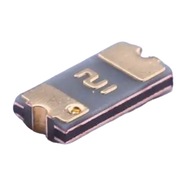


Bourns MF-NSMF020 Resettable Fuse 0.20A 24V 1206 SMD
Bourns MF-NSMF020 SMD resettable fuse, 0.20 A hold current, 24 V maximum voltage, 1206 package. Self-resetting after the fault is cleared, no replacement needed.
The MF-NSMF020 is a 1206 surface-mount resettable fuse that carries 0.20 A continuously and withstands 24.0 V maximum. The body measures 3.00–3.40 mm long, 1.40–1.80 mm wide and 0.48–0.85 mm high, with gold-plated terminals for reflow soldering. UL, CSA and TÜV recognised, AEC-Q200 qualified, RoHS compliant. Commonly used for overcurrent protection on USB port auxiliary rails, motherboard standby supplies and automotive control modules.
Category:Resettable fuse / SMD, 1206 SMD (3216 mm)
Voltage:24 V; Current:hold 0.2 A; trip 0.46 A.
Specifications
| Parameter | Value |
| Hold current | 0.2 A |
| Trip current | 0.46 A |
| Maximum voltage | 24 V |
| Maximum fault current | 10 A |
| Initial resistance | 0.6 Ω |
| Post-trip max resistance | 2.6 Ω |
| Trip current / time | 1 A / 0.6 s |
| Dissipated power | 0.6 W |
| Package | 1206 SMD (3216 mm) |
Temperature Derating
| -40℃ | -20℃ | 0℃ | 23℃ | 40℃ | 50℃ | 60℃ | 70℃ | 85℃ | |
| Hold current (A) | 0.3 | 0.27 | 0.24 | 0.2 | 0.18 | 0.16 | 0.14 | 0.12 | 0.11 |
| Share of 23 °C rating | 150% | 135% | 120% | 100% | 90% | 80% | 70% | 60% | 55% |
Product Description
What this product is
The MF-NSMF020 is a polymer resettable fuse wired in series between a supply and its load to limit current. Above its current limit the internal material heats, resistance rises and the loop current is held to a low value. Once the fault is cleared and the part cools, resistance falls back and the part conducts again, so the board does not come out for rework. The 1206 body suits boards with little space.
Dimensions and appearance
1206 package, 3216 in metric, body 3.00–3.40 mm long, 1.40–1.80 mm wide and 0.48–0.85 mm high. Nickel-plated terminals with a gold finish, one digit marked on top, a 2 on this 0.20 A part. Supplied on 8 mm tape for pick-and-place. This series cannot be wave soldered.
How it works
It sits in series between the supply and the load. At 0.20 A its own resistance is 0.60 Ω, which gives a drop of 0.12 V, 0.5 % of a 24 V bus. Above 0.46 A the internal material expands with heat, resistance climbs and the current is held to a low value. At a fault current of 1.0 A it opens within 0.60 s.
After the fault is cleared
When the part cools after a trip, resistance falls back to the low state and the loop runs again with no manual reset. After one trip the resistance is at most 2.60 Ω, 4.3 times the 0.60 Ω factory value, which gives 0.52 V at 0.20 A. That limit holds after repeated trips, so check the downstream circuit against it.
Parameters and selection
The full datasheet is available for download on this page and covers the derating table, time-current curves and package dimensions. At 60 °C inside an enclosure the hold current is 0.14 A, and 0.11 A at 85 °C; size the load against those figures. A 24 V battery reaches 28.8 V at full charge, past the 24.0 V rating, so this part suits a regulated 24 V bus only. For lot confirmation or an alternative, contact our sales team.
Selection Notes
1. Fault current on a 24 V bus easily passes 10 A
The 10 A interrupt rating means the part clears a fault at 24 V as long as the available fault current stays under 10 A; above that it may arc as it opens and suffer damage. A 24 V battery pack or a bus with large capacitors behind it often delivers tens of amps into a short. The MF-NSMF020X in the same footprint is rated 30 V and 60 A, and it carries the same digit 2 on top, so check the suffix on the reel label at goods-in.
2. A 1206 body sheds heat through its two pads
The body is only 3.2 mm long and 1.6 mm wide, so heat leaves through the two terminals into the copper under them. With less copper than the recommended pad, the body runs a few degrees above ambient, and the derating table is read against ambient, which leaves the part carrying less current than the table says. A board rated 0.14 A at 60 °C with undersized pads opens sooner. Lay out the recommended pads.
3. Between 0.20 A and 0.46 A it sits in a gap
The hold current is 0.20 A and the trip current 0.46 A, 2.3 times apart. A load drawing 0.30 A is outside the hold range and does not trip at once: the body heats, opens after minutes to tens of minutes, and the equipment runs fine at start-up then drops out, only to recover on a power cycle. Only above 0.46 A is a trip guaranteed, so read the time-current curve for loads inside that band.