

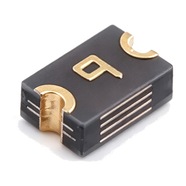


Bourns MF-PSMF110X Resettable Fuse 1.10A 6V 0805 SMD
Bourns MF-PSMF110X SMD resettable fuse, 1.10 A hold current, 6 V maximum voltage, 0805 package. Self-resetting after the fault is cleared, no replacement needed.
The MF-PSMF110X is an 0805 surface-mount resettable fuse that carries 1.10 A continuously and withstands 6 V maximum. The body measures at most 2.30 × 1.50 mm and up to 1.25 mm high, with gold-plated terminals, and it suits reflow soldering. UL recognised, RoHS compliant, halogen free. Commonly used for overcurrent protection on USB 2.0 and 3.0 ports, HDMI 1.4 sources, motherboard plug-in ports and phone charging ports.
Category:Resettable fuse / SMD, 0805 SMD (2012 mm)
Voltage:6 V; Current:hold 1.1 A; trip 2.2 A.
Specifications
| Parameter | Value |
| Hold current | 1.1 A |
| Trip current | 2.2 A |
| Maximum voltage | 6 V |
| Maximum fault current | 40 A |
| Initial resistance | 0.06 Ω |
| Post-trip max resistance | 0.21 Ω |
| Trip current / time | 8 A / 0.3 s |
| Dissipated power | 0.6 W |
| Package | 0805 SMD (2012 mm) |
Temperature Derating
| -40℃ | -20℃ | 0℃ | 23℃ | 40℃ | 50℃ | 60℃ | 70℃ | 85℃ | |
| Hold current (A) | 1.45 | 1.35 | 1.2 | 1.1 | 0.92 | 0.84 | 0.75 | 0.65 | 0.52 |
| Share of 23 °C rating | 132% | 123% | 109% | 100% | 84% | 76% | 68% | 59% | 47% |
Product Description
What this product is
The MF-PSMF110X is a polymer resettable fuse placed in series between a supply and its load to limit current. Above 2.20 A the internal material expands with heat, resistance climbs and the loop current is held to a low value. Once the fault is cleared and the part cools, it conducts again, so no board comes out for rework. The 0805 body is small enough to sit beside a connector.
Dimensions and appearance
0805 package, 2.00 to 2.30 mm long, 1.20 to 1.50 mm wide and 0.75 to 1.25 mm high, with 0.20 mm terminals in nickel and gold plating. Black body marked 6, the model code for this part; the production lot is printed on the carrier tape. All six models in the series share this footprint, so a change of model needs no pad revision. Supplied 3000 pcs per reel.
How it works
It sits in series in the loop. At 23 ℃ and 1.10 A its own resistance is 0.060 Ω, which gives a drop of 0.07 V, 1.3% of a 5 V rail. Above 2.20 A, or as ambient temperature rises, the internal material expands with heat, resistance climbs and the current is limited. At a fault current of 8.00 A it opens within 0.30 s.
After the fault is cleared
When the part cools after a trip, resistance falls back to the low state and the loop runs again with no manual reset. After one trip the resistance is at most 0.210 Ω, 3.5 times the 0.060 Ω factory value, which gives 0.23 V at 1.10 A. On a 5 V rail that 0.23 V is 4.6%; check the downstream circuit against that figure.
Parameters and selection
The full datasheet is available for download on this page, covering the derating table, time-current curves and package dimensions. At 60 ℃ inside an enclosure the hold current is 0.75 A, and 0.52 A at 85 ℃; size the load from the table at the highest enclosure temperature. For lot confirmation or an alternative for a 12 V rail, contact our sales team.
Selection Notes
1. 6 V keeps it inside 5 V systems
This part withstands 6 V maximum. A USB 5 V supply reaches 5.25 V at ±5%, which leaves 0.75 V of margin and is enough. A 12 V rail is over the ceiling the moment it is switched on, and one surge breaks the part down; a broken-down part goes open and the whole board loses power. For 1.10 A on a 12 V rail take the 1812 MF-MSMF110/16-2, and the MF-MSMF110/24X-2 for 24 V.
2. 1.10 A is the top of the 0805 range
The six models in this series run from 0.10 A to 1.10 A, and 1.10 A is the largest; anything above that moves to the 1812 package. In the tripped state the part dissipates 0.6 W, and the body measures only 2.3 × 1.5 mm, so the heat leaves through the two terminals into the pads. Do not shrink the pads: lay them out 1.00 mm wide as the datasheet shows so the heat has somewhere to go.
3. The body reaches 125 ℃ when tripped
The datasheet puts the maximum body surface temperature at 125 ℃, in the tripped state. On a board an 0805 sits next to electrolytic capacitors and plastic housings, and every overcurrent event runs that cycle once more. Leave clearance around the part, and do not pot the body solid: the material has to expand with heat, and a rigid housing shifts the trip point.