

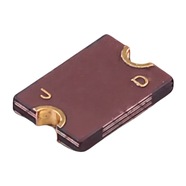


Bourns MF-LSMF300/24X Resettable Fuse 3.00A 24V 2920 SMD
Bourns MF-LSMF300/24X SMD resettable fuse, 3.00 A hold current, 24 V maximum voltage, 2920 package. Self-resetting after the fault is cleared, no replacement needed.
The MF-LSMF300/24X is a 2920 surface-mount resettable fuse that carries 3.00 A continuously and withstands 24.0 V maximum. The body measures 6.73–7.98 mm long, 4.80–5.44 mm wide and 0.75–1.60 mm high, with gold-plated terminals for reflow soldering. UL and TÜV recognised, AEC-Q200 qualified, RoHS compliant. Commonly used for overcurrent protection in automotive electronics, industrial controls and IEEE ports.
Category:Resettable fuse / SMD, 2920 SMD (7455 mm)
Voltage:24 V; Current:hold 3 A; trip 5.2 A.
Specifications
| Parameter | Value |
| Hold current | 3 A |
| Trip current | 5.2 A |
| Maximum voltage | 24 V |
| Maximum fault current | 20 A |
| Initial resistance | 0.02 Ω |
| Post-trip max resistance | 0.075 Ω |
| Trip current / time | 8 A / 5 s |
| Dissipated power | 1.5 W |
| Package | 2920 SMD (7455 mm) |
Temperature Derating
| -40℃ | -20℃ | 0℃ | 23℃ | 40℃ | 50℃ | 60℃ | 70℃ | 85℃ | |
| Hold current (A) | 4 | 3.55 | 3.2 | 3 | 2.5 | 2.25 | 2.15 | 1.85 | 1.5 |
| Share of 23 °C rating | 133% | 118% | 107% | 100% | 83% | 75% | 72% | 62% | 50% |
Product Description
What this product is
The MF-LSMF300/24X is a polymer resettable fuse wired in series between a supply and its load. A 3.00 A hold current with a 0.075 Ω post-trip limit keeps the series drop small, which suits heavy loads that cannot spare extra resistance in the path. The X suffix marks the freeXpansion construction, and the 3.00 A class is the only one built in both a 6 V and a 24 V version.
Dimensions and appearance
2920 package, 7455 in metric, body 6.73–7.98 mm long, 4.80–5.44 mm wide and 0.75–1.60 mm high, the largest board area in this class. Recommended pads sit 5.3 mm apart and are 4.6 mm wide. The 6 V version of the same 3.00 A class, MF-LSMF300X, is 0.35–0.85 mm high and can be told apart by height.
How it works
It sits in series in the loop. At 3.00 A its own resistance is 0.020 Ω, which gives a drop of 0.06 V, 0.25 % of a 24 V bus. Above 5.20 A the internal material expands with heat, resistance climbs and the current is held to a low value. At a fault current of 8.0 A it takes up to 5.00 s to open.
After the fault is cleared
When the part cools after a trip, resistance falls back to the low state and the loop runs again with no manual reset. After one trip the resistance is at most 0.075 Ω, 3.75 times the 0.020 Ω factory value, which gives 0.23 V at 3.00 A. Budget the downstream margin against 0.075 Ω; the 0.06 V from 0.020 Ω is the most favourable figure.
Parameters and selection
The full datasheet is available for download on this page and covers the derating table, time-current curves and package dimensions. At 60 °C inside an enclosure the hold current is 2.15 A, and 1.50 A at 85 °C; size the load against those figures. The 24.0 V rating does not cover a 24 V battery, which reaches 28.8 V at full charge, so this part suits a regulated 24 V bus. For lot confirmation or an alternative, contact our sales team.
Selection Notes
1. 33 V costs 1.15 A of hold current
The MF-LSMF185/33X in the same package and series is rated 33 V at 1.85 A, with a 0.150 Ω post-trip limit, twice the 0.075 Ω here. Every step up in voltage takes hold current and drop with it. A 24 V battery reaching 28.8 V at full charge goes past this 24.0 V version, so that rail needs the 185/33X, and the cost is 3.00 A becoming 1.85 A.
2. A large 2920 body takes 5.00 s to clear 8.0 A
The body is large and so is its thermal mass, which makes it slow: up to 5.00 s at 8.0 A, with only 1.7 times between the 3.00 A hold current and the 5.20 A trip current. For those 5 s the fault keeps drawing 8.0 A and a 24 V supply delivers 192 W, so traces, connectors and copper have to be sized for it. Below twice the rating it opens even more slowly; read the time-current curve.
3. 0.020 Ω is a floor, so budget at 0.075 Ω
RMin. in the datasheet is the lowest resistance a part may show, and R1Max. caps both the factory value and the value after repeated trips, so a new part measures anywhere from 0.020 Ω to 0.075 Ω. The 0.06 V from 0.020 Ω is the most favourable figure; 0.075 Ω gives 0.23 V at 3.00 A. Use 0.075 Ω in a drop budget and keep 0.020 Ω for the best case.