

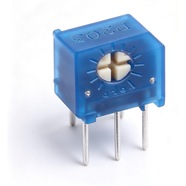


Bourns 3362P-1-203LF Trimmer Potentiometer 20 kΩ 3362 Series
Bourns 3362P-1-203LF 6.6×7.0×4.7 mm single-turn trimmer potentiometer, 20 kΩ, 0.5 W power rating. For on-board bias, reference and zero calibration.
The 3362P-1-203LF is a 6.6×7.0×4.7 mm through-hole single-turn trimming potentiometer rated 20 kΩ with 0.5 W, adjusted from the top face over 240°. Three pins on a 2.54 mm pitch, through-hole soldered, LF for the 100 % tin-plated version. Used in high-voltage sensing dividers where the load on the driving stage stays light.
Category:Trimmer potentiometer / 3362 系列
Resistance:20 kΩ;Power rating:0.5 W
Specifications
| Parameter | Value |
| Series | 3362 |
| Nominal resistance | 20 kΩ |
| Resistance tolerance | — |
| Power rating | 0.5 W |
| Turns | Single turn |
| Linearity | — |
| Temperature coefficient | ±100 ppm/℃ |
| Mechanical rotation | 270 ° |
| Dimensions | 6.6×7.0×4.7 mm |
Other Resistances in This Series
| Model | Resistance | Tolerance | Power |
| 3362P-1-103LF | 10 kΩ | — | 0.5 W |
Product Description
What this product is
The 3362P-1-203LF is a 1/4 inch square single-turn trimmer. At 20 kΩ a sensing divider draws little current, so the load on the preceding stage stays light and one adjustment settles the setting. A single-turn part adjusts quickly, with no turns to count on the line.
Dimensions and appearance
Body 6.6×7.0×4.7 mm, cross slot 2.77 mm long, 0.64 mm wide and 0.89 mm deep for the H-90 tool. Three pins 0.46 mm in diameter on a 2.54 mm pitch, soldered through the board. The top face carries the 203 code, pin numbers, model and date code; tubes hold 50 pcs.
How it works
The wiper reaches either end in 240° of rotation against a 270° mechanical angle. Resistance from terminal 1 to 2 falls with the angle while the 20 kΩ from 1 to 3 stays fixed, so a divider taps the voltage at terminal 2. Past either end the wiper idles and over-turning does no harm.
How to choose
In the part number, 203 is the resistance code: the first two digits 20 are the significant figures and the third digit 3 means × 10³, so 20 kΩ; 103 is 10 kΩ. At 20 kΩ, 0.5 W allows 100 V at 5 mA. The series datasheet lists no resistance tolerance, and a divider trims any offset out.
Parameters and documentation
The full datasheet is on pages 1 and 2 and can be downloaded from this page, with the resistance table, environmental tests, outline dimensions and tape drawings. Operating range -55 °C to +125 °C, temperature coefficient ±100 ppm/°C, stop strength 0.049 N·m. For lot confirmation, contact our sales team.
Selection Notes
1. At 20 kΩ the 0.5 W rating needs 100 V
√(0.5 W × 20 kΩ) = 100 V at 5 mA. A 24 V loop draws 1.2 mA through 20 kΩ for 0.029 W. In high-voltage sensing, 100 V is the ceiling for this value; above that move to a 3296 or a 3590 with wider voltage headroom.
2. 240° across 20 kΩ leaves 83.3 Ω per degree
Screwdriver repeatability of 2° to 5° puts two settings 167 Ω to 417 Ω apart. On a 20 kΩ single turn that 417 Ω is 2 % of full scale, enough to shift the divider output, so the line needs a locating fixture.
3. The P style takes a knob, ordered with suffix T
The 3362P is one of the top-adjust styles, and adding T to the order code gives the finger knob version, which ships in tubes only. A knob repeats less closely than a screwdriver, so use it where the part is set once and then touched up in the field.